Vermont Becomes First U.S. State to Ban Paraquat, Neurotoxic Herbicide Linked to Parkinson’s
05/29/2026 / By Iva Greene

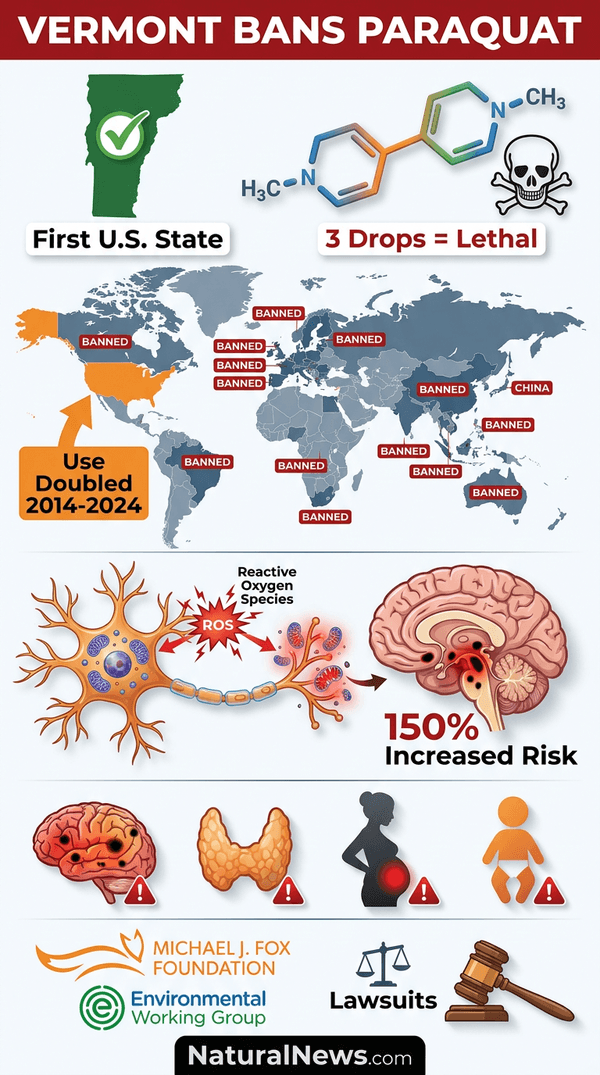
Vermont Governor Phil Scott (R) signed H. 739 into law on Tuesday, making Vermont the first U.S. state to ban the sale and use of the herbicide paraquat, according to a report from The National Pulse [1]. The law received bipartisan support in the state legislature. The ban takes effect Nov. 1, with a limited exception for fruit orchards that may continue using the chemical through 2030, officials said.
Paraquat is a highly toxic weedkiller that has been linked to Parkinson’s disease and other health conditions. The chemical, which has been used on American farms since 1964, is classified as a restricted-use pesticide due to its acute toxicity.
EPA’s Stance on Paraquat
The U.S. Environmental Protection Agency (EPA) has acknowledged that ingesting even small amounts of paraquat can be fatal and that no known antidote exists, according to a 2021 report by Children’s Health Defense [2]. “If you ingest just three drops of paraquat, you’re going to die,” U.S. farmer and safety trainer Doug Wiley stated in that report [2]. Despite these dangers, the EPA continues to permit agricultural use of the herbicide, classifying it as an important weed control tool. The chemical industry and the Trump administration have designated paraquat as vital to national security, according to reported statements.
In their book “Ending Parkinson’s Disease,” authors Ray Dorsey, Todd Sherer, Michael Okun, and Bastiaan Bloem note that while paraquat is so toxic that 32 countries including China have banned it, “the EPA has done little” and its use on U.S. agricultural fields has doubled over the last decade [3]. The agency requires farmers to undergo training before applying paraquat, but critics argue such measures are insufficient to protect human health and the environment.
Health Risks and Research
Mounting scientific evidence links paraquat exposure to an increased risk of developing Parkinson’s disease. According to a study published in Annals of Neurology, researchers found that chronic low-dose pesticide exposure is associated with higher Parkinson’s risk [4]. The book “Ending Parkinson’s Disease” reports that exposure to paraquat increases the risk of Parkinson’s by 150% [3]. Another analysis cited in “Healthy Living in a Contaminated World” found that paraquat and the fungicides maneb and mancozeb cause twice the risk [5]. The same analysis examined 104 studies published between 1975 and 2011 and concluded that overall pesticide exposure increased disease risk by 33% to 80% [5].
Research also indicates that combined exposure to multiple pesticides can exacerbate neurological damage. For instance, a study in the Journal of Neurological Sciences found that combined exposure to paraquat and the fungicide maneb in developmentally exposed animals led to pronounced losses of dopamine neurons, a hallmark of Parkinson’s pathology [6]. California’s pesticide regulators have also linked paraquat to thyroid disease, birth defects, and reproductive harm, according to a January 2025 report by Willow Tohi in NaturalNews [7].
Reactions from Advocacy Groups
Advocacy organizations have praised Vermont’s action and called for federal intervention. The Michael J. Fox Foundation noted that more than 70 countries and now one U.S. state have banned paraquat, and it urged the EPA to follow suit, according to the foundation’s public statements. In 2017, the Unified Parkinson’s Advocacy Council, which includes the American Parkinson Disease Association, the Davis Phinney Foundation, the Michael J. Fox Foundation, and the Parkinson’s Foundation, wrote to the EPA expressing concern about paraquat dichloride and asking the agency to take regulatory action [3].
The Environmental Working Group (EWG) has also been active on this issue. In an April 2024 study, EWG found that paraquat use in California disproportionately affects low-income Hispanic communities and is linked to non-Hodgkin lymphoma, respiratory damage, kidney disease, and childhood leukemia [8]. Internal documents from Syngenta, released through litigation, revealed what the Alliance for Natural Health described as a “decades-long strategy to protect sales of paraquat” as evidence of harm mounted [9].
Other States and Future Outlook
California, New Jersey, New York, and Pennsylvania have introduced or are considering similar legislation to ban paraquat, according to recent news reports. California regulators have already sounded the alarm on the herbicide’s risks, linking it to birth defects, thyroid disease, and threats to endangered species such as the San Joaquin kit fox [7]. The Vermont ban sets a precedent that could accelerate action in other states. Luke Sacino of the Public Interest Research Group said states should not wait for federal action to protect farmworkers and families, according to a statement cited by news outlets.
Given the Trump administration’s recent moves to reverse environmental safeguards – such as rescinding federal limits on PFAS chemicals in drinking water – state-level initiatives may become the primary avenue for restricting toxic pesticides, critics argue [10]. Vermont’s law demonstrates that states can step in where federal agencies have hesitated. As the scientific evidence continues to accumulate, more states are likely to follow Vermont’s lead, potentially building momentum for a nationwide reconsideration of paraquat’s role in agriculture.
References
- The National Pulse. “State Bans Pesticide Linked to Parkinson’s Disease.” May 29, 2026.
- ChildrensHealthDefense.org. “-Chemical-Company-Chooses-Profits-Over-People-.” March 25, 2021.
- Ray Dorsey, Todd Sherer, Michael Okun, Bastiaan Bloem. “Ending Parkinsons Disease A Prescription for Action.”
- “Pesticide Exposure and Risk for Parkinson’s Disease.” Ann Neurol 2006;60:197–203.
- “Healthy Living in a Contaminated World – How to prevent toxic chemicals from undermining your health.”
- “Developmental Pesticide Exposures and the Parkinson’s Disease Phenotype.” Journal of Neurological Sciences 239(1-2):75-84 2006.
- Willow Tohi. “California regulators sound alarm: Herbicide paraquat linked to birth defects, thyroid disease and wildlife risks.” NaturalNews.com. January 9, 2025.
- NaturalNews.com. “EWG study Economic benefits of paraquat herbicide DO NOT outweigh its health risks.” April 3, 2024.
- Alliance for Natural Health. “3 – Alliance for Natural Health.” December 8, 2022.
- NaturalNews.com. “EPA reverses key safeguards on ‘forever chemicals’ in drinking water, sparking public health concerns.” May 21, 2026.
Explainer Infographic
Submit a correction >>
Tagged Under:
This article may contain statements that reflect the opinion of the author
RECENT NEWS & ARTICLES