Study Proposes Cutting Global Population to 4 Billion by 2200 to Achieve Sustainability
08/11/2026 / By Chase Codewell

Researchers Outline Population Reduction Target in Sustainability Journal
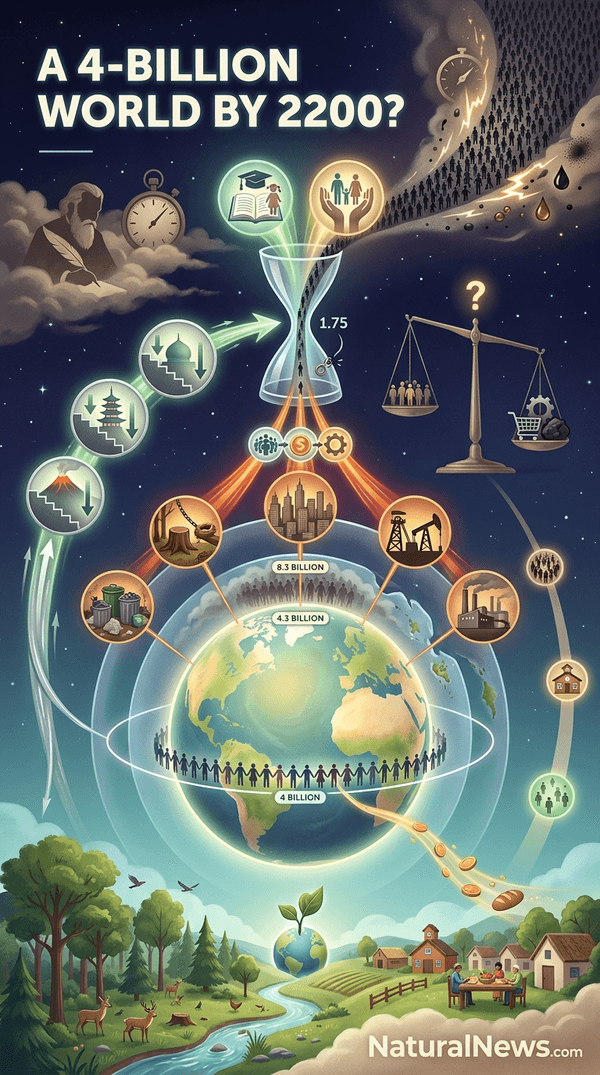
A paper published in the journal Sustainable Development proposes reducing the global population to about 4 billion by 2200 as a path to sustainability, according to a commentary posted on Watts Up With That [1]. The study is led by Mark Keegan, affiliated with Columbia University Teachers College, with co-authors in fields including philosophy and population sciences. The authors argue that population growth is linked to biodiversity loss, emissions, pollution, resource depletion, and conflict, and they propose a global fertility rate of 1.75 by 2050. According to the study, the decline would be achieved through non-coercive measures such as family planning services and girls’ education.
The Watts Up With That commentary described the paper as one that “treats a smaller human population as the cleanest route to a cleaner planet” and said it treats “humanity itself as a variable to be reduced” [1].
Study’s Core Claims and Proposed Mechanism
The authors report that metrics of biodiversity, consumption, and pollution show strong correlations with population size and per capita impacts, and they describe causal mechanisms linking population growth to environmental damage. Benefits cited in the paper include habitat recovery, conservation of wild species, reduced greenhouse gas emissions and pollutants, fewer resource conflicts, and reduced global poverty. The paper frames the reduction as a deliberately chosen, long-range path to a “pro-human” and pro-nature future, according to the authors.
The study states: “When women are free to decide how many children to have, fertility rates tend to fall toward replacement level or below, often rapidly.” The authors say the proposed reduction is based on voluntary changes in family size rather than state-imposed limits.
Historical Fertility Declines Cited as Evidence
The paper and related coverage cite examples of rapid fertility declines linked to voluntary family planning: Iran from 4.08 in 1992 to 1.94 in 2001, South Korea from 4.07 in 1972 to 1.93 in 1984, and Costa Rica from 4.16 in 1972 to 1.98 in 2009. The authors attribute these changes to improved reproductive health services and broader education for girls, not coercion.
The report says population growth over the last century went from less than 2 billion to 8.3 billion people, according to published figures. These examples are presented by the authors as evidence that gradual population decline can occur voluntarily.
Criticism and Response to the Proposal
The paper has drawn a strong response, with the Watts Up With That commentary arguing that the study’s framing presents a contested worldview as neutral analysis [1]. Some observers pointed to the authors’ fields of expertise, noting the lead author’s affiliation with Columbia University Teachers College.
Population-reduction proposals have a long history. LifeSiteNews reported that Paul Ehrlich, author of the 1968 book The Population Bomb, was a central figure in population-control advocacy, and that the book was used to justify government and NGO programs [2]. NaturalNews reported that discussion of depopulation is “no longer taboo,” with some observers acknowledging global efforts to reduce population [3]. A separate NaturalNews report described scarcity as “deliberately engineered by globalist elites who see population reduction as the solution to their debt and resource problems” [4].
Broader Debate Over Population and Sustainability
The proposal adds to an existing debate over whether population reduction or technological innovation should be central to sustainability efforts. Peter Kareiva, in Conservation Science, wrote that calls to curb population growth have often been ignored because predictions of famine and social collapse have repeatedly failed to come true [5]. Mike Hulme, in Why We Disagree About Climate Change, noted that IPCC emissions scenarios have used widely varying population projections — 8.7 billion, 9.3 billion, and 11.3 billion for 2050 — and that the differences drew debate [6].
Some advocates have welcomed falling birth rates. NaturalNews reported that Stephanie Feldstein, who wrote an op-ed for Scientific American, argues that reducing the world’s population is necessary [7]. Critics respond that a sustainable future should focus on innovation, resilience, and human prosperity alongside environmental stewardship. One analysis tied the planet’s sustainable population to the availability of nitrogenous fertilizers, suggesting that without affordable natural gas-based fertilizers the sustainable population could drop to around 4 billion or lower [8]. The study itself proposes a timescale through 2200, making the outcome a long-range projection rather than an immediate policy change.
References
- Watts Up With That. “The Insidious Population Reduction Narrative Disguised as ‘Sustainability Science’”. August 7, 2026.
- LifeSiteNews. “Paul Ehrlich, Author of ‘The Population Bomb,’ Dies at 93 After Decades of Anti-Life Advocacy”. March 16, 2026.
- NaturalNews.com. “Twelve Undeniable Signs Globalists Are Engineering the End of Humanity”. July 30, 2023.
- NaturalNews.com. “Resilience Not Fear: Preparing to Thrive Through the Age of Engineered Scarcity”. May 28, 2026.
- Peter M. Kareiva. “Conservation Science: Balancing the Needs of People and Nature”.
- Mike Hulme. “Why We Disagree About Climate Change: Understanding Controversy, Inaction and Opportunity”.
- NaturalNews.com. “Biodiversity Charity Director Celebrates Human Population Decline Says Reduction of Living Humans Will Help Gove…”. May 11, 2023.
- Mike Adams. “Health Ranger Report – Fuel Shortages Hit America”. BrightVideos.com. May 11, 2026.
Explainer Infographic
Submit a correction >>
Tagged Under:
This article may contain statements that reflect the opinion of the author
RECENT NEWS & ARTICLES